


Lagoon funding lags – and manatees pay the price
Lagoon funding lags – and manatees pay the price
For the Florida Legislature to fully fund the Indian River Lagoon Protection Program in the upcoming budget session is more than a matter of state leaders fulfilling a promise; it’s a matter of life and death… for thousands of manatees.
In January 2023, Gov. Ron DeSantis issued Executive Order 23-06 asking the legislature to establish the Indian River Lagoon Protection Program, a pledge to secure at least $100 million annually for the next four years for projects to improve water quality in the lagoon.
The Legislature responded by unanimously approving the money; and that December, the funds were divvied up among 21 projects including 11 septic-to-sewer conversion projects, which are necessary, especially in the northern lagoon, and happen to be a favorite of an administration that prefers to look away from agriculture’s inputs to the lagoon.
Other projects included wastewater treatment plant upgrades, $10 million for muck dredging in Brevard County’s Grand Canal and other needed restoration projects that together keep an estimated 375,000 pounds of algal bloom-feeding nitrogen out of the lagoon each year.
But is the promised funding dwindling?
The 2024-25 budget delivered the promised $100 million; a total of 25 projects were funded including septic-to-sewer conversions, baffle box installations and nutrient reduction efforts.
But for the 2025-26 spending year, the state lists only 14 IRL Water Quality Improvement Grant projects — totaling just $25 million. And while the Florida Legislature hasn’t agreed on a 2026-27 budget, initial proposals peg Indian River Lagoon spending at a little over $33 million — well below that $100 million per year figure.
It’s unclear what’s happened to the rest of the money promised by DeSantis for the lagoon. But if the apparent shortfall in funding persists, that will be a problem, as $100 million per year is really only a start in terms of what the lagoon needs to see real improvements.
Back in November 2021, the Indian River Lagoon National Estuary Program assembled a list of over 1,000 projects needed to restore water quality in the lagoon. The cost: about $5 billion in 2020 dollars, or about $250 million a year over 20 years.
That money is crucial to saving the lagoon — and its most iconic species.
As go manatees, so goes the lagoon
The good news: According to the 2025 IRLNEP Annual Report, local, state and federal investments in the lagoon can, and do, make a difference. Seagrass is beginning to recover in parts of the lagoon, for example, thanks in large part to water quality improvement programs.
The bad news: the lagoon’s iconic manatees continue to struggle.
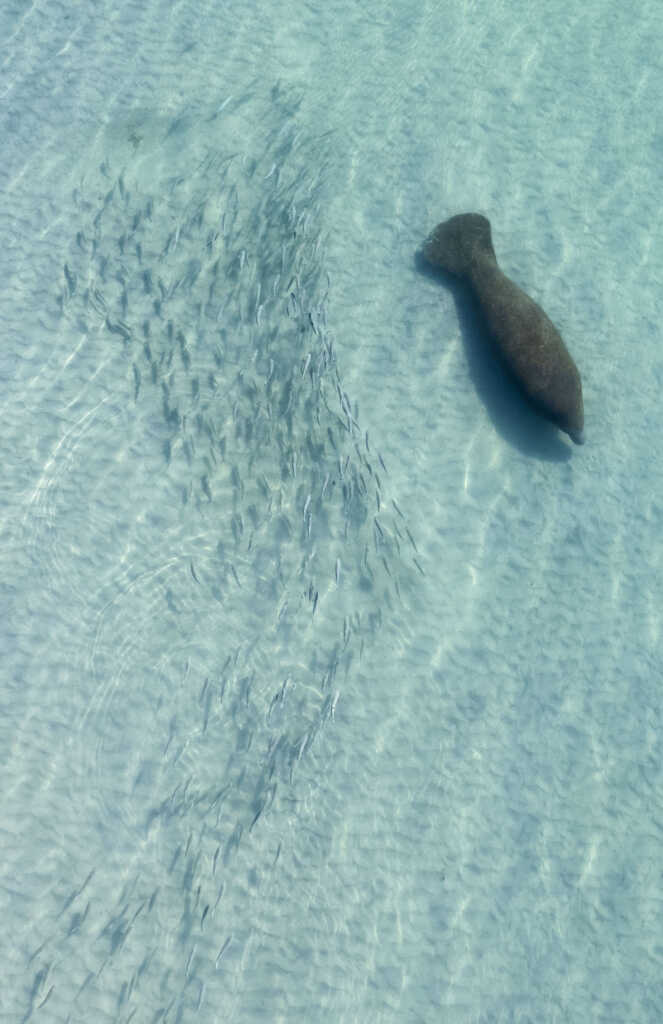
Manatees in the lagoon are like enormous canaries in the coal mine. Keeping nutrient pollution out of the lagoon helps keep manatees alive. From 2020 to 2022, shading from nutrient-fueled algal blooms killed off thousands of acres of seagrass beds in the lagoon; and over 1,200 manatees, a species that relies on seagrass for food, died from starvation.
The massive die-off led the nonprofit Bear Warriors United to sue the Florida Department of Environmental Protection in 2022, claiming the agency’s failure to enforce clean-water regulations caused the deaths. Last year a federal judge ruled in the group’s favor, saying the DEP’s wastewater regulations violated the federal Endangered Species Act and ordered the state to enact stronger pollution controls, restore seagrass beds and develop a habitat conservation plan to prevent future manatee starvation.
The DEP appealed, and a trial is scheduled April 21 in Atlanta.
After peaking at 1,100 in 2021, the yearly number of statewide manatee deaths dropped to 555 in 2023, then 565 in 2024. But surviving manatees are subject to chronic malnourishment for the rest of their lives. And they’re more susceptible to another major killer: cold stress.
Data from the Florida Fish and Wildlife Conservation Commission shows that statewide through March, 238 manatees have died so far in 2026. If that pace keeps up, it could result in 952 deaths, the highest figure since 2021.
Of those 238 deaths, 39 have been attributed to cold stress. The primary counties that border the Indian River Lagoon have seen a total of 41 manatees die so far this year, 10 from cold stress.
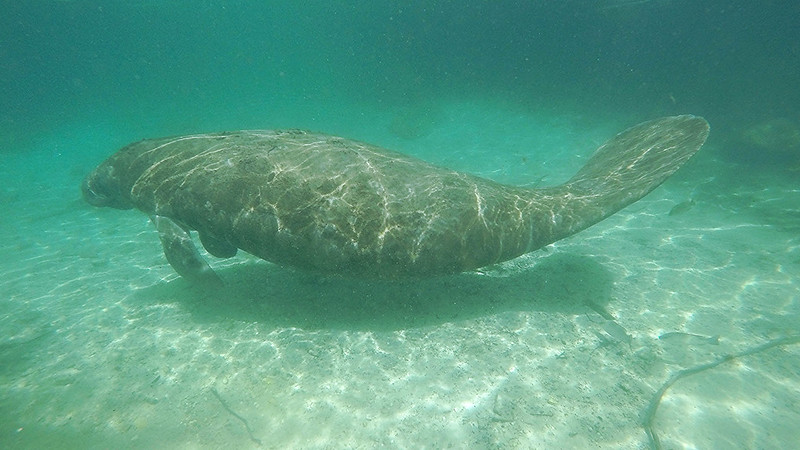
As Elizabeth Neville, director of environmental law and policy for the Save the Manatee Club, noted in a recent column in the Orlando Sentinel, the “greatest long-term threat to manatees is loss of essential warm-water habitat that manatees require to survive cold weather.”
Florida’s primary warm-water habitats for manatees include nine natural springs and four thermal basins. Only five springs systems are used by large numbers of over-wintering manatees.
But because of water-gulping development and the resulting habitat loss, over 60% of Florida’s manatees now depend on outfalls from six power plants for warmth. (Even though the former Henry B. King Power Plant in downtown Fort Pierce is no longer functioning, manatees still gather at its old outflow on Moore’s Creek. It’s now the site of the Manatee Observation and Education Center.)
Power plants, especially along the Indian River Lagoon, tend to be in areas where seagrass, manatees’ primary food, is scarce, leaving manatees in a damned-if-you-do, damned-if-you-don’t situation: stay at a warm-water site and risk starvation or venture out to find food and risk dying from cold stress.
And it’s only going to get worse as many power plants are expected to change operations or be retired over the next 30 years.
‘Unsustainable situation’
“This is an unsustainable situation; outages leave manatees vulnerable, and in the future, most power plants plan to transition their technology to methods that no longer discharge warm water,” Neville wrote.
A better alternative would be for the Legislature to invest in the Florida Manatee Warm-Water Habitat Action Plan, which was first developed by the FWC and the U.S. Fish and Wildlife Service to ensure a long-term network of warm-water refuges for manatees by:
- Restoring and protecting natural springs, such as the “lost springs” in the Ocklawaha River, which flows north from central Florida to the St. Johns River near Palatka. Restoration would include breaching the Kirkpatrick Dam (formerly Rodman Dam) to reinstate vital migratory routes for fish and manatees and provide crucial warm water habitat for manatees.
- Supporting research into artificial warm-water sites, such as the Faka Union Canal in Naples, where the Army Corps of Engineers and the South Florida Water Management District enhanced a warm-water refuge for manatees by digging deep basins that trap warm water near the bottom of the canal.
But will the Legislature allocate the funding? Or could the money come from the Indian River Lagoon Protection Program — if in fact it gets the full $100 million this year?
The truth is the lagoon has more needs than it does dollars. Local advocacy groups fight heroically for funding and the state isn’t the only source; local and federal dollars key to restoration efforts.
But the IRL needs the $100 million promised by Gov. DeSantis back in 2023. And that’s looking iffy.
The Floridians First 2026-2027 budget proposal DeSantis announced in December includes $100 million for priority areas of the Indian River Lagoon and Biscayne Bay. The Florida House budget proposal, HB 5001, included about $33.5 million for Lagoon spending. But the Florida Senate Budget proposal, appears to spend far less — just $700,000 is specifically allocated for Lagoon projects.
We certainly expect the chambers to settle on a figure closer to the House number – but in light of the Governor’s $100 million per year promise, it’s nowhere close to “enough.”
While state funding is not the only source of money for lagoon projects, anything less than the $100 million is bound to have consequences on the lagoon — and the creatures who call it home.