


Deep Dive: Florida Bay always one threat away from devastation
Deep Dive: Florida Bay always one threat away from devastation
Florida Bay is thirsty.
Yes, a 1,100-square-mile body of water spreading between the southern tip of the Everglades and the Florida Keys can be thirsty – for fresh water.
In fact, the bay is “on the brink of devastation” from a lack of fresh water, said Jennifer Rehage, a professor at the Institute of Environment at Florida International University.
And that would be devastating to the shrimp, lobster, crabs, sea turtles, gamefish, crocodiles, sponges, corals, queen conchs and manatees that rely on the largest continuous seagrass beds on Earth, which are found in Florida Bay.
The current drought in much of South Florida is the immediate cause of the problem. An Aug. 20 National Weather Service report said western Miami-Dade County, home of Everglades National Park, was in “extreme drought” and reported that the Florida Keys on the east side of Florida Bay received just 3.59 inches of rain from June 21 to Aug. 19,

41% of normal precipitation. Four fires burned portions of the park in August.
But the root of the problem: Structural changes to South Florida’s natural plumbing system, through canals supplying water to sugarcane fields in the Everglades Agricultural Area and South Florida’s burgeoning population, cutting off most of the historic flow of freshwater from Lake Okeechobee to Florida Bay.
Right now, the amount of freshwater entering Florida Bay has dropped about 75% from its historic levels, Rehage said.
With so little freshwater flowing south from Lake O, “the largest single source of fresh water into Florida Bay is direct rainfall over the bay itself, which accounts for more than 45 percent of its freshwater input,” according to the South Florida Water Management District.
An October 2018 news release by the SFWMD refers to Florida Bay as “a largely rainfall-driven system” as that’s what it’s supposed to be. But rainfall on the bay isn’t enough to sustain the health of the bay, which Rehage said “is like a kid on the edge of starvation. It’s already in serious condition. It won’t take much now to tip it over the edge.”
Estuary in peril
The name Florida Bay is somewhat misleading, implying that it’s simply an arm of the salty Gulf of Mexico. Florida Bay is actually an estuary, where a flow of freshwater from the mainland mixes with the saltwater from the Gulf of Mexico to make what is (or what should be, at least) a brackish body of water that’s saltier than freshwater but less salty than ocean water.
A 2020 National Park Service news release noted that it’s normal for salinities in the bay to fluctuate with the seasons. During the wet season, rain and freshwater flowing into the bay outpace evaporation, keeping salinity lower. During the dry season and droughts, however, rainfall and freshwater flows drop off while evaporation continues, causing increased salinity.
But even with this seasonal fluctuation, salinities should rarely rise to those above normal sea water, which is known as hypersalinity.
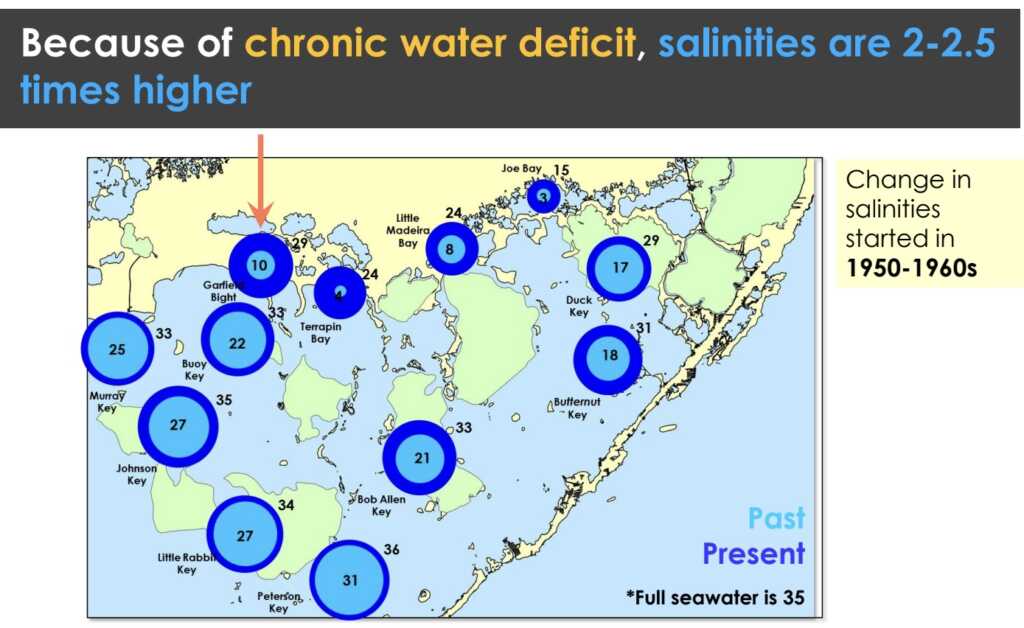
Salinity in Florida Bay should range from about 8 parts per thousand (ppt) close to the mainland, where freshwater enters the bay, and gradually increase close to the level of sea water, about 35 ppt, as you go south toward more open water around the Florida Keys.
“Now salinity in the bay is up to 50 (parts per thousand),” Rehage said. “The water is too salty and too hot, and that kills seagrass.”
In a snowball effect: Decaying seagrass releases nutrients into the water, which can lead to algal blooms. The blooms block sunlight from the remaining seagrass so that they can’t photosynthesize food, and they die.
That’s what happened during the drought year of 2015, when salinity levels peaked at over 70 ppt, more than twice the salinity level of sea water. That year, 40,000 acres of seagrass in the bay died.
That kind of die-off hasn’t occurred this year – at least not yet.
Good conditions since the 2015 drought have meant that “we came into this current drought with a healthy resilient seagrass community,” Rehage said. “Hopefully, they’ll be able to tolerate the drought we’re seeing. But they can only take so much. Plants are definitely stressed out. They’re shedding their leaves to try to cope. You can see mats of seagrass leaves floating in the water.”
And without rain, harsh conditions will be exacerbated as shorter days mean the plants will have less sunlight to photosynthesize food.
On the plus side – at least for seagrass in Florida Bay – South Florida is heading into the heart of hurricane season.
Although no one hopes for a storm, “a hurricane could keep Florida Bay alive,” Rehage said. “Or a tropical storm with a lot of rain, or if it just starts raining every day.”
But we can’t count on Mother Nature to fix what we’ve screwed up, and efforts are underway to increase the flow of freshwater into Florida Bay, including:
- A massive project that replaced more than 3.5 miles of the Tamiami Trail, a 1920s roadway through the Everglades from Miami to Naples and north to Tampa that prevented water from flowing south, with two long bridges that helped unblock the “River of Grass.”
- A similar project along Taylor Slough, a major flow-way in the southeastern Everglades until construction of Old Ingraham Highway in the 1920s reduced and redirected freshwater away from the slough
But it’s not enough
Rehage isn’t particularly impressed.
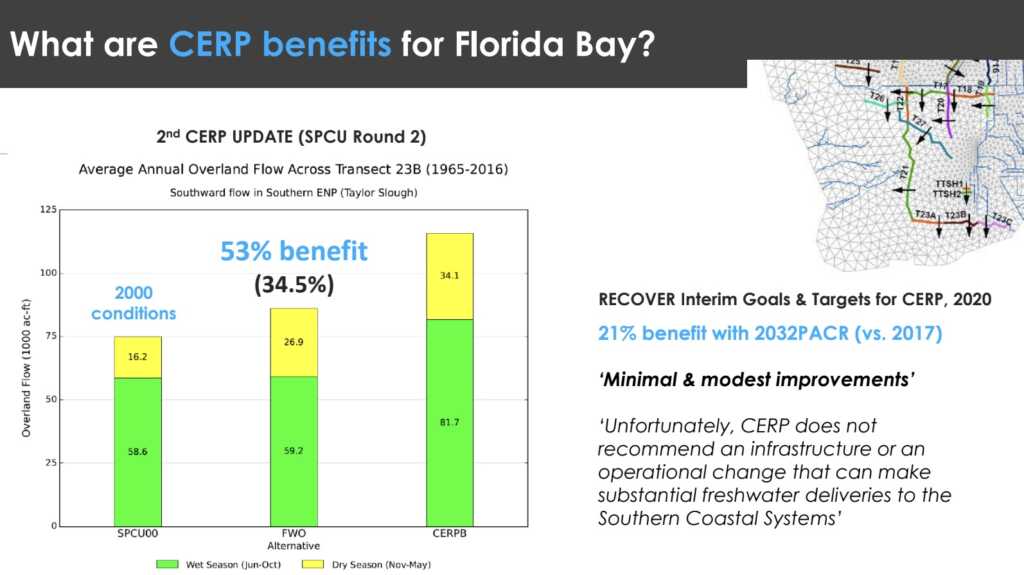
At best, the renovation projects in place are supposed to improve current conditions by 50%, she said. “So you’re still talking about a 50% improvement of a 75% deficit. What we need is a 400% improvement to get back to normal. And I couldn’t say the projects that have been coming online since the 2015 drought are helping because up until the start of the current drought, there’s been plenty of water. The projects haven’t been tested by drought until now.”
Basically, projects designed to help send more water south need water to send.
That’s where a project like the Everglades Agricultural Reservoir, when it’s completed in 2029, should make more of an impact.
The 10,500-acre reservoir will be able to hold about 78 billion gallons (enough water to fill more than 118,000 Olympic-sized swimming pools). But the reservoir will provide “dynamic” rather than “static” storage, not just holding water but continuously sending water south toward the Everglades. Over the course of a year, the reservoir is designed to “turn over” three to four times, sending 360 billion to 480 billion gallons of water to the Everglades.
And the freshwater flowing into Florida Bay has to be clean.
According to the Florida Museum of Natural History: “Elevated concentrations of nitrogen and phosphorus enter the estuary as rainwater runoff carrying agricultural fertilizers. While these nutrients are used in agricultural lands, within aquatic systems these nutrients cause algae blooms. When algal populations expand rapidly, the oxygen is taken up from the water, reducing the amount available for other aquatic organisms. Algae blooms also block much of the sunlight needed by seagrasses to carry out photosynthesis.”
To that end, alongside the reservoir is a 6,500-acre stormwater treatment area to remove fertilizer residue (nitrogen and phosphorus) as the water flows slowly through the constructed marshes.
 “The benefits of the restoration projects are modest at best, which is why we need to buy more land in the EAA,” Rehage said, referring to the Rescue the River of Grass campaign by Friends of the Everglades.
The campaign calls for the state to acquire at least 100,000 acres of land in the Everglades Agricultural Area. Research has shown that much land, in addition to the EAA Reservoir, is needed to restore the flow from Lake Okeechobee to the southern Everglades and Florida Bay by building a 76,923-acre, 13-feet-tall reservoir and a 25,667-acres stormwater treatment area to clean the water as it moves south.
Reviving the natural flow of water south will also help curtail the unnatural flow of water from Lake O east to the St. Lucie River estuary and west to the Caloosahatchee River estuary, where low salinity can lead to toxic algal blooms that sicken people, their pets and wildlife, including dolphins, manatees and sea turtles.
Lake Okeechobee will also benefit as lower water levels boost the growth of submerged aquatic vegetation. And using the land for environmental restoration will keep it from falling victim to commercial exploitation, such as proposed rock mines.
“We need more water so Florida Bay won’t always be one threat away from devastation,” Rehage said. “Let’s put on our pants and do it.”