


How important will corruption be to voters on Nov. 3?
How important will corruption be to voters on Nov. 3?
Republican pollster Kristen Soltis Anderson wrote in the New York Times (paywalled) this week that pocketbook issues — most notably the price of gas — will be a major factor in the upcoming midterm elections, and that’s not good for President Trump and the GOP.
But it was her second point that caught our eye, a second issue she sees rising in the polling, ranking just below the cost of living but ahead of other concerns. “It’s not just the economy,” she writes. ‘It’s the corruption,’ too.”
Writes Anderson: “Voters don’t think the economy is working for them, and they think it’s being rigged more and more in favor of a precious few who are cozied up to our nation’s leaders.”
 That’s obviously bad news for Trump and others at the top of the federal food chain. But how about here in Florida? To what extent will Florida voters punish candidates for corruption? After all, it’s not like crookedness is a new invention in Florida — though there may be an argument that it’s getting worse.
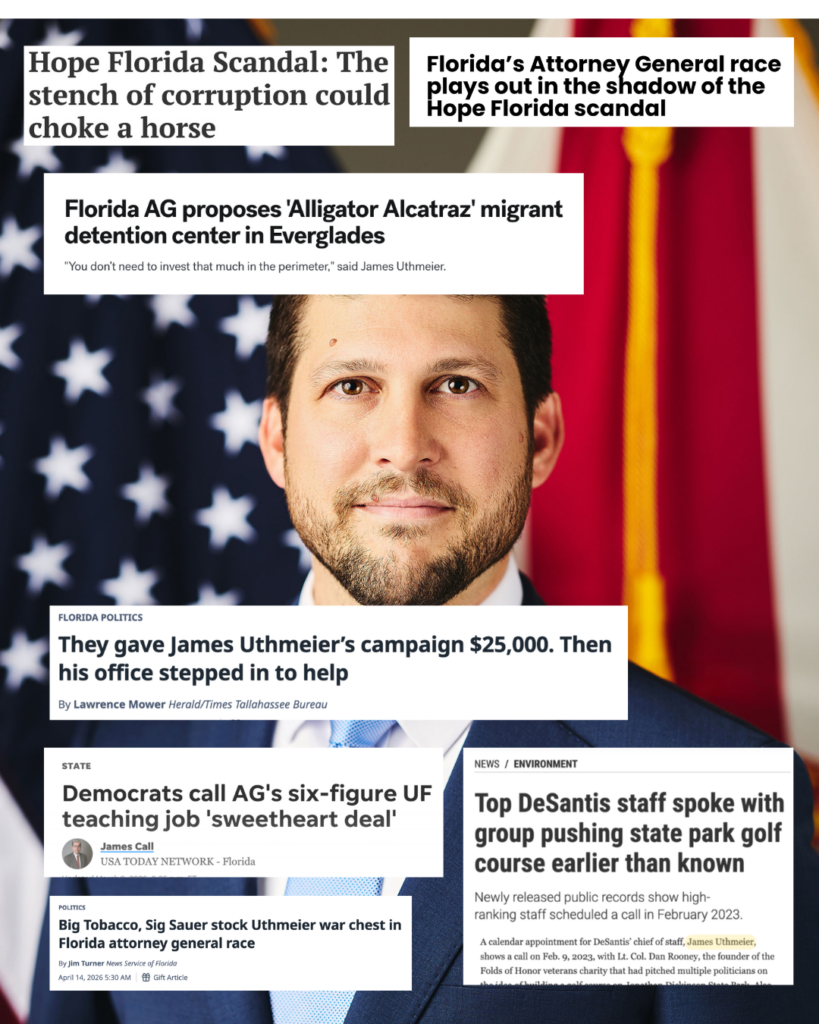
We have dwelled on the recent Hope Florida scandal, and in particular Attorney General James Uthmeier’s central role in the grand jury investigation. But Hope Florida was just one straw on the camel’s back; it came quickly on the heels of “Alligator Alcatraz,” the $1.2 billion (and counting) debacle in the Everglades, where Uthmeier again played a pivotal role — this time as the supposed mastermind behind the whole idea.
There was the Destin land deal, where a politically connected developer sold four acres for an unbelievable $83 million. Uthmeier took $25,000 in campaign cash from that politically connected developer and then, as a member of the Florida Cabinet, voted “yes” on the deal.
And now, Tampa Bay Times staffers say his office is thwarting their attempts to further document what happened by charging exorbitant fees for public records.
Then of course we had the state parks development controversy, where the DeSantis Administration sought to permit golf courses, hotels and pickleball courts to be built in Florida’s beloved parks. Uthmeier again played a central role, then as DeSantis’s Chief of Staff, meeting secretly with those who wanted to build a golf course in Martin County’s Jonathan Dickinson State Park.
In Florida, where there’s corruption, there’s a good chance you’ll find Uthmeier. He’s hardly the only one, of course; but he may be the epitome of the problem.
He’s the consummate insider; he’s taken campaign cash from virtually every special interest imaginable. The Orlando Sentinel, in endorsing his opponent Jose Javier Rodriguez, called Uthmeier DeSantis’s “chief henchman.”
At VoteWater we’ve long believed corruption to be a root cause of dirty water. We believe the system is rigged in favor of special interests and their “dirty money,” campaign cash which affords them undue political influence. That’s why we push for political change; because continued corruption guarantees the continued degradation of our waterways.
This is why VoteWater endorsed Rodriguez in the AG race. As a state legislator Rodriguez was a reliable environmental champion. And he has made corruption a central focus of his campaign; he is for the little guy, he is for you. His opponent is for the special interests, and ultimately the status quo that’s gradually squeezing your family’s budget.
Will voters punish Uthmeier for this? Anderson suggests that if gas prices were “normal,” if prices weren’t rising, maybe not. Voters can put up with corruption when times are good.
When they’re not, being a consummate insider larded down with corporate campaign cash and trailed by salacious headlines could turn out to be a liability — even in Florida.