


DEEP DIVE: How Florida lawmakers diverted conservation funds to cover routine expenses
DEEP DIVE: How Florida lawmakers diverted conservation funds to cover routine expenses
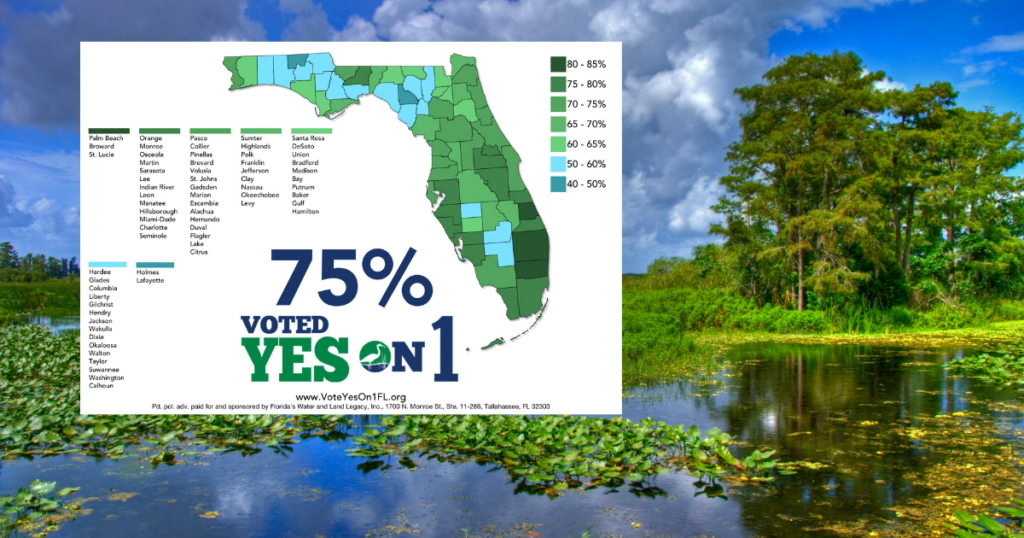
Despite a failed lawsuit and years of scrutiny, Florida’s Land Acquisition Trust Fund still funds routine agency expenses — even as $750 million meant for conservation sits uncommitted.
A DirecTV subscription, 1,000 camouflage baseball caps and a display booth at a Broward County Family Exposition.
Do those sound like land purchases to you?
And they’re just some of the small-change items bought with appropriations from the Florida Legislature with money that 75% of the state’s voters said they wanted spent on acquiring land for conservation.
In November 2014, voters overwhelmingly approved Amendment 1 to the Florida Constitution, which requires that one-third of the money paid for documentary stamp taxes on real estate transactions (aka “doc stamps”) be dedicated to the Land Acquisition Trust Fund.
To be clear, this was not a new tax; it’s just the people saying how they want money from existing taxes to be spent.
The amendment says the money can be used to: “acquire, restore, improve, and manage conservation lands including wetlands and forests; fish and wildlife habitat; lands protecting water resources and drinking water sources, including the Everglades, and the water quality of rivers, lakes, and streams; beaches and shores; outdoor recreational lands; working farms and ranches; and historic or geologic sites.”
When the law took effect July 1, 2015, it was expected to secure $648 million in Fiscal Year 2015-16 and more than $10 billion over the course of its 20-year lifespan.
But because of the dramatic increase in property values and the number of property transactions, Amendment 1 is expected to generate at least $1 billion each year. In fiscal year 2025-26 alone, the Land Acquisition Trust Fund collected over $1.2 billion, and from now through the end of its duration in FY 2033-34, Amendment 1 is expected to generate another $14.2 billion.
That can preserve a lot of land. And it has. Funds from Amendment 1 have been used to buy, for example:
- A 3,094-acre conservation easement in the Little Orange Creek Corridor Project in Putnam County that serves as a key connection within the Ocala-to-Osceola Wildlife Corridor, protecting habitat for rare and imperiled species.
- A 1,670-acre conservation easement in the Bar-B Ranch Project in Martin County next to the C-44 Stormwater Treatment Area, part of the Comprehensive Everglades Restoration Plan that benefits the St. Lucie River Estuary, the Indian River Lagoon and the Greater Everglades ecosystem.
- A 1,400-acre conservation easement in the Big Bend Swamp/Holopaw Ranch Project in Osceola County that will help link conservation lands between Bull Creek and the Three Lakes Wildlife Management Area, including a wildlife crossing under the Florida Turnpike to ensure safe passage for animals.
- A 543-acre acquisition in the Northeast Florida Timberlands and Watershed Reserve in Duval County that will protect habitat for species such as the gopher tortoise while restoring water quality in the Lower St. Johns River Basin. (The parcel had been approved for residential development but will instead be managed as part of Cary State Forest.)
Mangling ‘manage’
But remember the wording of the amendment says the money can be used to “acquire, restore, improve, and manage (emphasis added) conservation lands …”
Some politicians put a lot of emphasis on the “manage” part and used a very broad definition of “manage” as well, arguing that pretty much any expense that traditionally had been paid with general revenue funds could use Amendment 1 money instead.
That’s how the state Department of Environmental Protection’s central district office justified spending $1,118.69 in Amendment 1 money for that DirecTV service. The Department of Agriculture and Consumer Services spent $449,091 from the fund to cover all the expenses at its Office of Water Policy, including $8,800 for those baseball caps distributed to farmers to raise awareness of programs with environmental benefits.
And the DEP took $1,042,662 to cover almost 90% of the expenses for its office of Coastal & Aquatic Managed Areas, including $500 to rent that booth at the Broward County Family Exposition.
In response, a collection of environmental groups in 2015 sued the Legislature and several state agencies for misappropriation of taxpayer money, alleging legislators and state agencies used a large chunk of the money meant for land acquisition to pay routine operating expenses at state departments, including vehicle purchases and salaries.
“When you look at (the first five years of Amendment 1’s lifespan), at least a third of the funds have actually gone to what we would call operational or administrative expenses,” Aliki Moncrief, executive director of Florida Conservation Voters, one of the groups that filed the lawsuit, told public radio station KFSU as the lawsuit slogged its way through the judicial system.
Here are some of the other ways environmental groups involved in the lawsuit found government agencies spending money from Amendment 1’s Land Acquisition Trust Fund. You decide if the money was used to buy or manage public lands:
- The Department of State spent $676,418 to fund 80% of the expenses at its Division of Cultural Affairs. Of that money, the agency spent $1,125 to secure space at an art exhibition and $530.80 on textbooks and competition rule books for National History Day.
- The state Legislature appropriated over $21 million to the Department of Agriculture and Community Services to implement the use of “Non-point Sources Best Management Practices,” which pays farmers 75% to 90% of the cost for new practices or projects that improve the pollution management of their farms, including irrigation techniques, fertilizing equipment and water reuse. A worthy program, perhaps — but not land acquisition.
- The Agriculture department also spent $2,819,038 for about 90% of the salaries and benefits for 41 positions at its Office of Agricultural Water Policy Coordination, which is supposed to facilitate communication among federal, state, and local agencies and farmers on water issues.
- Nearly $9.4 million was used by the state to pay all the “fixed capital outlay” costs for Total Maximum Daily Loads (aka TMDLs), a program aimed at reducing pollution in bodies of water that exceed legal limits. The idea is to determine how much pollution the body of water can safely assimilate (the TMDL), then work to keep pollution at or below those thresholds.
- The Agriculture department’s Forest Service spent $135,172 to pay 100% of its overtime costs, even though only about 14% of the wildfires agency personnel fought (5,348 of 37,877) were on public land.
- The state Legislature appropriated $6,527,320 to pay 100% of the salaries and benefits for all 95 positions at the state Department of Environmental Protection’s office of Technology and Information Services, which provides IT services to the entire DEP.
- The state Legislature appropriated $40,550,981 for salaries and benefits for the Forest Service, but the agency reported spending only $19,308,907 for managing Florida’s 37 state forests and another $7,538,100 to assist other agencies in land management for other agencies, a practice known as “secondary management.”
- The state Legislature appropriated $1,137,549 for expenses at the Division of Historical Resources, although only $501,430 of expenses were expended for public lands management.
- The state Legislature appropriated $16,018 for executive direction and support services at the Department of Environmental Protection, $2,694.90 of that on 10 computer monitors for the Office of General Counsel.
It goes without saying, but we’ll say it anyway, that the state should spend money on fighting fires, curtailing pollution and buying computer monitors in its lawyers’ offices, IT services and even history textbooks.
But 75% of Florida voters said they wanted Amendment 1 money spent solely on buying conservation lands.
Alisa Coe, a lawyer with the environmental law firm Earthjustice that filed the lawsuit, called the state’s actions “kind of thumbing their nose at the voters.”
The first judge to hear the case agreed.
In June 2018, Leon County Circuit Judge Charles Dodson ruled the Legislature misspent millions of dollars that should have gone to land conservation programs and that the Land Acquisition Trust Fund should be used as intended: For land acquisition and only land acquisition.
The Legislature appealed, and in September 2019, the First District Court of Appeals overturned Dodson’s decision, noting that the amendment’s language also allows money to be used for refinancing the bonds for buying land. So based on that slight error, the panel, which didn’t elaborate on exactly how the Amendment 1 money could be spent, sent the case back to the circuit court.
By this time Dodson had retired and his replacement, Circuit Judge Laye Smith, in October 2022 threw out the case, arguing that the money in question had already been spent and the state agencies couldn’t repay it. (It’s like a judge telling a bank robber, “Well, you’ve already spent the money you stole, so I’ll dismiss the charges against you.”)
The appeals court agreed, and when the environmental groups asked the Florida Supreme Court for a review, the state’s highest judges declined.
“The mootness finding ended our litigation,” Coe said in an email to VoteWater.
Lesson unlearned
Although the Legislature escaped punishment from the courts, did they learn their lesson and stop misusing Amendment 1 money?
The simple answer is “No.” In fact, they seemed emboldened by their chicanery.
In the state appropriations bill approved this year for fiscal year 2026-27, the Legislature dipped deeply into the Land Acquisition Trust Fund to pay expenses that have little or nothing to do with land acquisition. The appropriation for the DEP, for example, includes:
- $32,521 for risk management insurance.
- $47,829 for a human resources services contract
- $1,433,865 for salaries and benefits at the Florida Geological Survey
- $8,492,674 for salaries and benefits at the Technology and Information Services office
- $2,753,781 for salaries and benefits at the Land Administration and Management office
- $17,340,067 for salaries and benefits at regulatory district offices
Even with the questionable and possibly unconstitutional misspending, the Land Acquisition Trust Fund remains underutilized for its constitutional purpose: buying land.
For example, number crunching by the Friends of the Everglades found that of the $1.26 billion distributed to the LATF for fiscal year 2025-26, $750 million remains uncommitted.
Also, the Florida Legislature appropriated only $18 million for Florida Forever this year, far short of the minimum $100 million it’s required by law to give the land acquisition program annually.
Where could the unused money go? Well, Amendment 1 specifically states that the money can be used to buy “lands in the Everglades Agricultural Area and the Everglades Protection Area.”
That ties in nicely with the Friends of the Everglades “Rescue the River of Grass,” an initiative backing the acquisition of at least 100,000 acres of land in the Everglades Agricultural Area.
Research has shown that much land, in addition to the EAA Reservoir now under construction, is required to restore the flow of clean freshwater from Lake Okeechobee to the southern Everglades and Florida Bay, where it’s desperately needed; restrict the unnatural flow of water to the St. Lucie River and Caloosahatchee River estuaries, where it causes toxic algal bloom; and prevent commercial exploitation, such as proposed rock mines, in the greater Everglades.
Farmland in the EAA typically sells for $8,000 to $15,000 per acre “depending on soil quality and water rights, significantly higher than agricultural land in central Florida counties due to the premium black muck soils and established drainage infrastructure,” according to Florida Land Offers, which buys and sells land in Palm Beach County. (BTW: That “established drainage infrastructure” that helps jack up EAA land prices includes canals and stormwater treatment areas paid for with tax dollars.)
So even at the high end of land prices ($15,000 an acre), that unspent $750 million could buy up to 50,000 acres, half the area needed to “Rescue the River of Grass.”
And all without raising taxes. It’s just a matter of using state revenue how it’s supposed to be used – where 75% of taxpayers said they want it used.