


‘Dirty money’ talks: What does it say about Byron Donalds?
‘Dirty money’ talks: What does it say about Byron Donalds?
Florida Congressman and Republican gubernatorial candidate Byron Donalds can talk a good game about clean water. When he first ran for Congress he identified it as a top priority; he’s advocated for Everglades funding, and on his campaign website he vows to “complete Everglades Restoration, improve water quality, expand access to water supply, and protect our beaches and natural resources that make Florida the most beautiful state in the nation.”
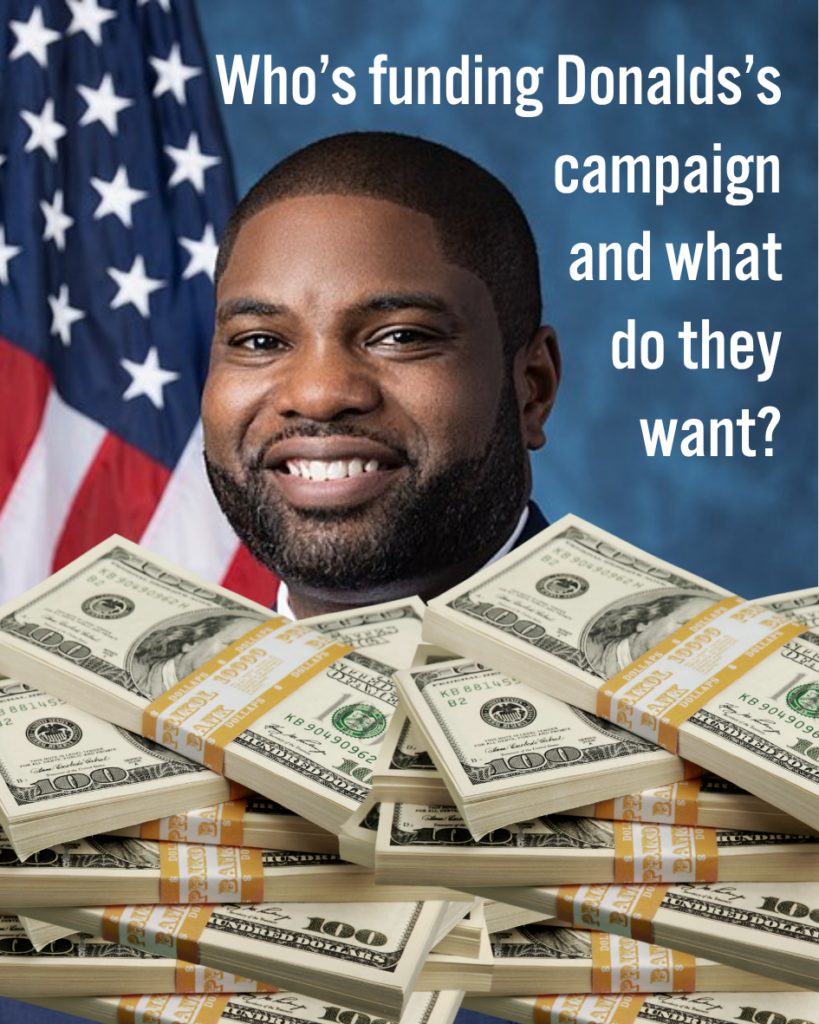 His voting record as a Congressman doesn’t exactly back up this rhetoric — and the stack of “dirty money” he’s collected to fund his gubernatorial run doesn’t fill us with confidence, either.
Between his campaign and his political action committee (Friends of Byron Donalds), Donalds has raised more than $42 million. That dwarfs the amount raised by any other gubernatorial candidate; presumed Democratic front-runner David Jolly has raised about $3 million in total. That gives Donalds a 14-to-1 advantage.
But it’s not the size of Donalds’ haul that gives us pause — it’s where the money came from and what that suggests about how he might govern if he becomes Florida’s next Governor.
SEE THE DATA: Donalds campaign contributions
SEE THE DATA: Friends of Byron Donalds PAC contributions
His specific donor coalition — utilities, developers, agricultural interests, and ideological anti-regulation funders — are all likely to benefit when water regulations are loosened or enforcement is de-emphasized.
The bulk of Donalds’ money — more than $38 million — comes via his political action committee, Friends of Byron Donalds. Of this, nearly $3 million came from real estate developers, construction companies, and housing financers.
This suggests that development pressures in Florida would continue — maybe intensify — under Donalds as Governor. We could see further attempts to curtail environmental restrictions on “sprawl,” open up protected lands to more growth and continued pressure to limit local governments’ land use authority — a trend under Gov. Ron DeSantis in recent years.
Big Sugar has not given any money directly to Donalds or his PAC; but political committees funded in part by the sugar industry have given generously, effectively serving as a conduit for sugar money to the candidate. The Associated Industries of Florida PAC has given $525,000; the Florida PC committee gave more than $237,000.
NextEra Energy and Duke Energy, Florida’s two dominant utility companies, each gave $500k — perhaps in hopes of a lighter regulatory touch, and favorable rate structure decisions.
And Mosaic Global Sales LLC, the phosphate mining firm based in Tampa, has given Donalds’ PAC $200,000.
Bottom line: Florida’s waterways need a champion in the Governor’s Mansion. But Donalds’ campaign finance record suggests he would govern on clean water the same way he has voted while in Congress — supportive of project funding and rhetorically committed to clean water, while systematically weakening the regulatory infrastructure that actually contributes to cleaner water.