


These incumbents were reelected with no opponents – but plenty of money
These incumbents were reelected with no opponents – but plenty of money
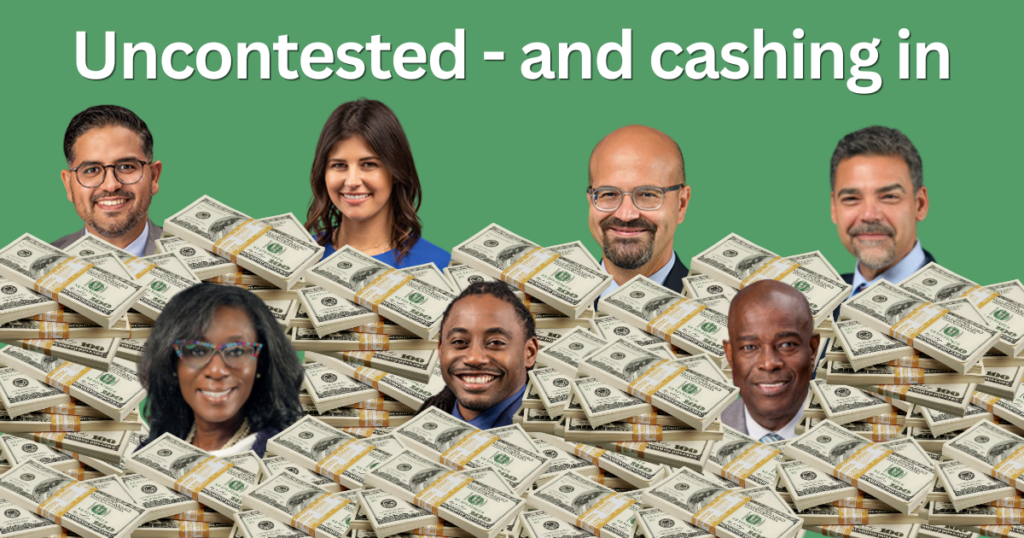
Due to the fact they had no competition — either in the August primary nor the November general elections — several south Florida lawmakers have already been “reelected.”
From the Miami Herald: “In Miami-Dade County, incumbent Republican Reps. Demi Busatta of Coral Gables, Alex Rizo of Hialeah, David Borrero of Sweetwater and Tom Fabricio of Miami Lakes all qualified without opposition. Democratic incumbents who avoided opposition include Reps. Felicia Simone Robinson of Miami Gardens, Wallace Aristide of Miami-Dade County and Daryl Campbell, whose district spans portions of Broward and Miami-Dade counties.”
Borrero in particular earned our ire earlier this year due to his defense of House Bill 399, which sought to undermine the Urban Development Boundary by commissioning a “study” to determine if the boundaries in Miami-Dade and other counties should remain in place. That language was eventually removed from the bill, but as we said back in March, “Why would Borrero back more development in environmentally sensitive areas? Vote against him!”
But with no opponents, he and the other incumbents are back.
Curiously, a lack of competition rarely means a lack of money. Borrero’s campaign, according to state records and our own Dirty Money Project, raked in $40,000 in contributions this cycle while facing no competition. His political action committee “Floridians for Prosperity” brought in even more, $154,950, during the cycle.
Busatta’s campaign brought in $64,500; her PAC, “People Above Politics,” raked in $414,000, including large donations from “polluter PACs” like the Associated Industries for Florida’s Prosperity PAC and the Florida Chamber of Commerce Alliance PAC.
Rizo’s campaign collected just under $55,000; his PAC, “Principled Moral Conservatism,” raked in $371,681, with the biggest check ($50,000) written by a shadowy PAC called “The Committee” which itself is almost entirely funded by another PAC called “Florida PC.” That PAC got $950,000 from Florida Crystals and some $2 million from real estate development interests.
Fabricio’s campaign brought in just under $55,000; his PAC, “True Freedom PC,” collected $187,500 from a wide variety of donors.
On the Democratic side, Simone Robinson brought in just over $26,000; her PAC, “Felicia for Florida,” brought in just $9,500. Aristide’s campaign collected just over $20,000; his political committee, “Miami-Dade District 2 United,” appears defunct. Lastly, Campbell’s campaign brought in $26,500; his PAC, “Generation Next Rising Stars,” has closed.
To be fair, many of these candidates and their PACs collected donations early in the cycle when it wasn’t clear whether they’d have an opponent or not. But the money kept flowing even as we inched closer to last week’s qualifying deadline. Why? Because the goal of political giving isn’t merely to get candidates elected; it’s to cultivate influence. You donate big bucks a candidate who faces no foe, or an even bigger check to his or her PAC, and they’ll remember who you are and what you want.
Running unopposed, it turns out, is remarkably lucrative for both the candidates — and the industries that would influence them. Who knew democracy could be so profitable?